In a context where social media is gradually becoming the primary communication space for young people, slang is no longer merely a vehicle for conveying information but is evolving into a pop culture symbol. Grasping this shift, YouNet Media officially launches Slang Reply 2025 – the first in-depth analysis report on slang on social media.
Built upon social listening data from YouNet Media’s SocialHeat platform, the Slang Reply 2025 report goes beyond simply listing trending keywords; it delves deep into decoding “lifecycles”, tracing “origins”, and distilling practical “formulas” to help brands understand and communicate effectively with digital users. Download the report here.
Disclaimer: Data in this report was collected by the SocialHeat system from public posts on platforms including Facebook, Youtube, TikTok, Threads, Forums, Blogs, and Online News. The measurement period ranges from Jan 01, 2025 to Dec 31, 2025. Demographic data is based on public declarations by users on Social Media.
1. 2025 Slang Landscape: Telling Numbers of a Vibrant “Playground”
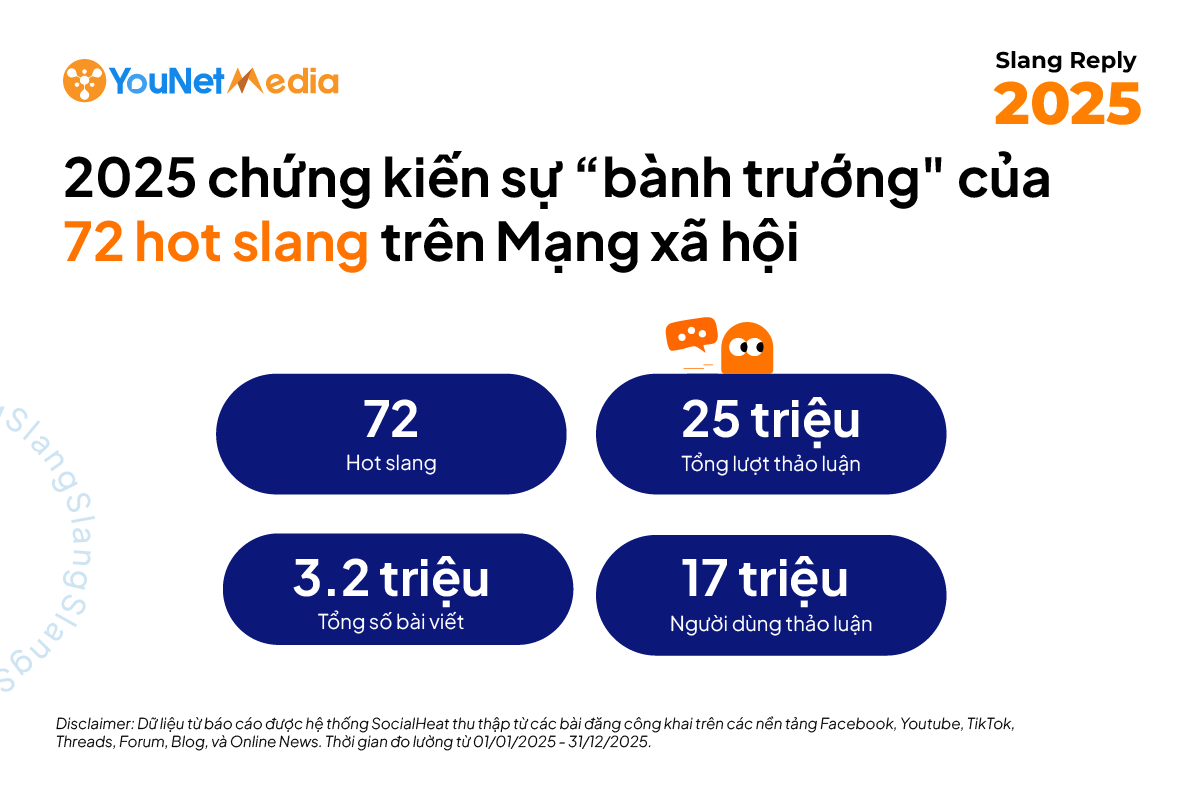
Data from the Slang Reply 2025 report shows that in 2025, Vietnamese social media recorded the emergence of 72 hot slang terms, generating 25 million discussions with the participation of 17 million users. These figures clearly reflect a reality: slang is no longer a phenomenon limited to small communities or purely spontaneous; it has become a common language, widely used in communication, comments, and content creation on social media, especially among the youth.
Disclaimer: Slang is defined as sayings & phrases widely used by the online community
Notably, discussions about slang are not evenly distributed throughout the year but exhibit distinct seasonality. Major holidays such as April 30 – May 1, National Day (Sept 2), and especially the summer season, act as powerful “catalysts” for the explosion of slang.
June 2025 alone – the peak of summer – generated 8.27 million discussions, making Q2 2025 the most vibrant period, accounting for nearly 60% of total slang discussions for the entire year. This demonstrates that slang does not appear randomly; rather, it is closely tied to the rhythm of social life and community milestones.
2. TikTok and Facebook: Two Synergistic Roles on Social Media
Platform analysis reveals a clear division of roles within the slang propagation ecosystem. TikTok accounts for 70% of total discussions, affirming its position as the source and shaper of viral slang. With the characteristics of short-form video content, rapid spread speed, and high repetition, TikTok has become the “cradle” where slang is born, transformed, and widely disseminated in a short time.
Meanwhile, Facebook plays the role of an amplifier for the heat of slang. Once slang appears on TikTok and shows “signs” of going viral, large community pages on Facebook – being “keen” to trends – quickly join the game, contributing to spreading the slang to their follower communities. Additionally, trendy brands also incorporate slang into communication and commercial contexts on their owned channels.
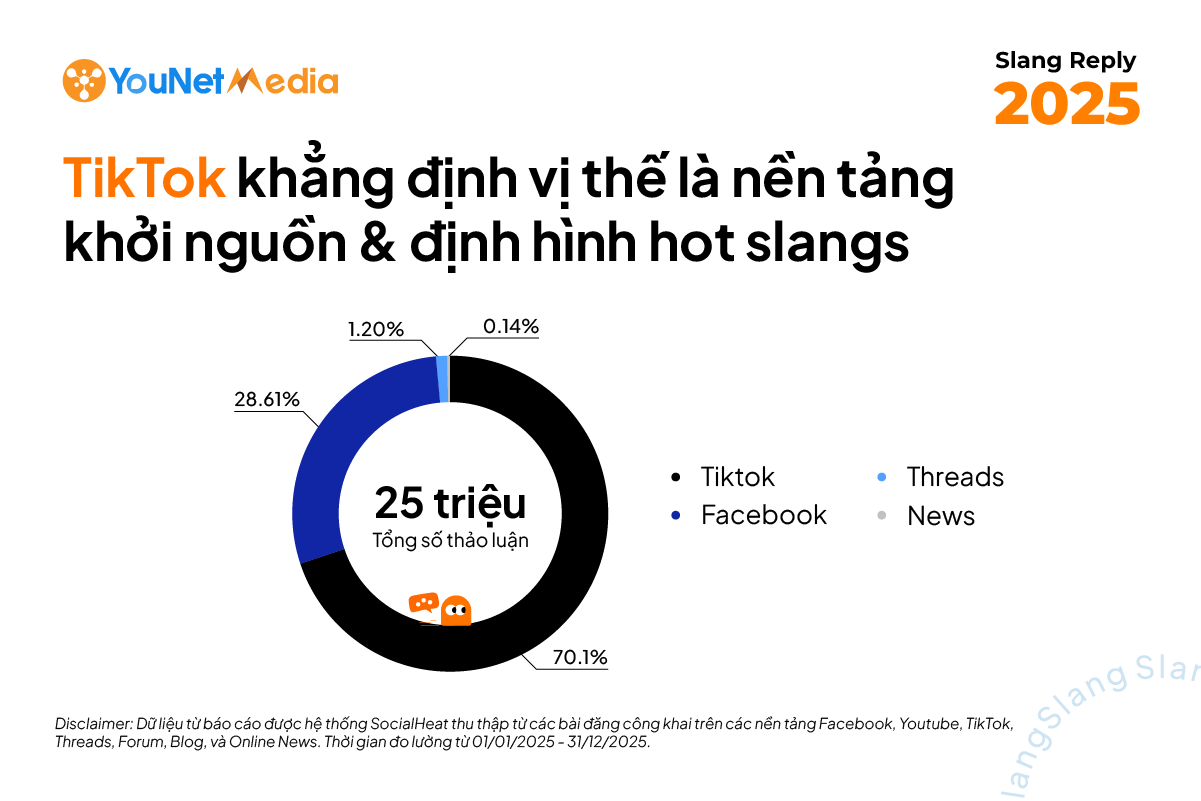 It is precisely this combination of TikTok – the production hub for new linguistic trends – and Facebook – the space for expanding and prolonging discussions – that has created a flow of trends, turning slang into a major phenomenon on social media in 2025.
3. What do the Top 10 Hottest Slang Terms of 2025 Reveal About Digital Culture?
Beyond the overview landscape, Slang Reply 2025 also announces the Top 10 slang terms most discussed on Vietnamese social media in 2025, accounting for nearly 65% of the total discussion volume regarding slang for the entire year.
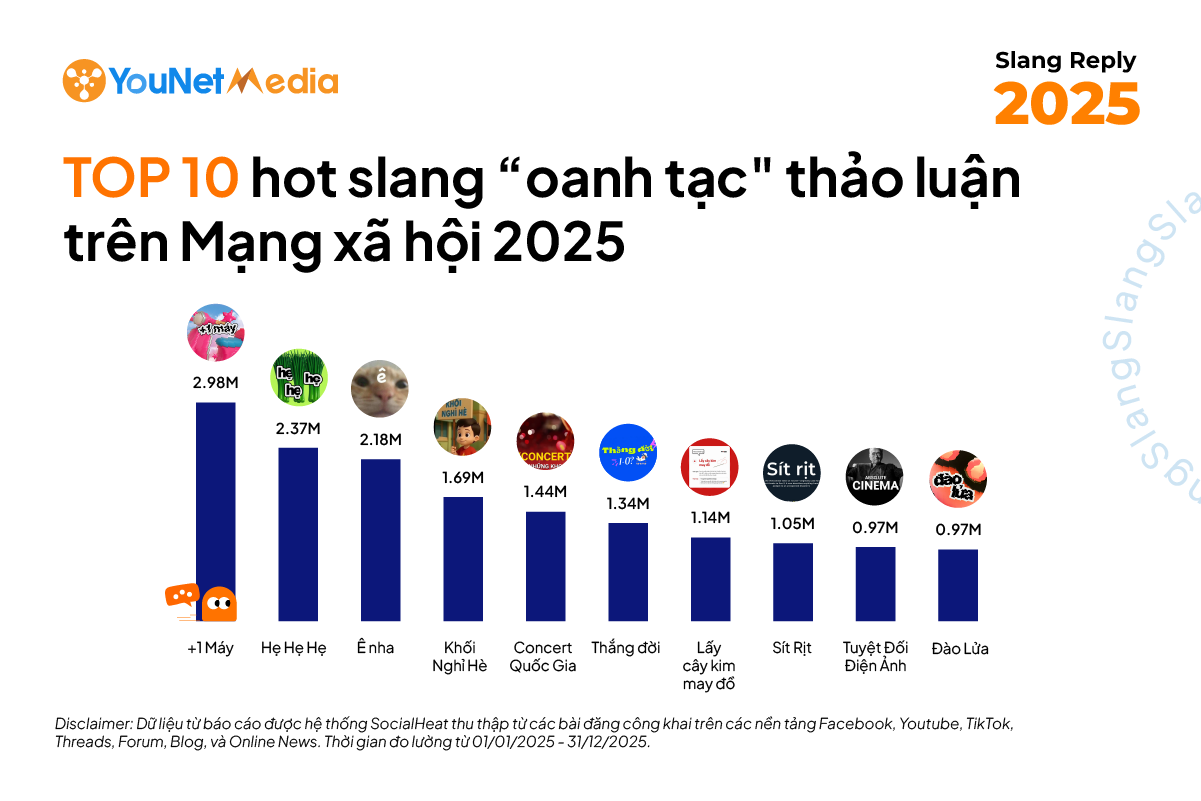 Leading the ranking is the slang “+1 Máy”, with nearly 3 million discussions, far outperforming the remaining slang terms. This is a type of slang with an extremely short structure, easy to use in various communication contexts. It helps users express agreement or join a conversation quickly, thereby driving strong virality on the TikTok platform.
Following close behind are slang terms with humorous nuances drawn from daily life such as “Hẹ Hẹ Hẹ”, “Ê nha”, or keywords associated with major national events like “Khối Nghỉ Hè”, and “Concert Quốc Gia”. The diverse presence of slang ranging from daily life and events to music in the Top 10 demonstrates that a viral slang does not necessarily originate from celebrities or methodical communication campaigns. Instead, it can stem from very ordinary sayings or purely natural moments in everyday life.
4. Conclusion: When Slang Becomes the Key to Communication on Social Media
Through the Slang Reply 2025 report, it is evident that slang has become an indispensable part of the communication language of the youth on social media. The large scale of discussions, the clear division of roles between platforms, and the influence concentrated on specific standout slang terms indicate that this is no longer a fleeting phenomenon.
However, behind that vibrancy lie larger questions for brands pursuing the journey of trend-catching on social media: How long does a hot slang usually ‘live’? Is the slang suitable for the target audience the brand is aiming for? How should brands use slang to achieve positive results while still ensuring consistency with their established image?
These questions will be decoded in the Slang Reply 2025 report, opening up a more comprehensive perspective on slang lifecycles and user behavior in the digital space. Download the full report here.