The agriculture industry is a complex ecosystem, made up of multiple sub-sectors, distribution layers, and stakeholder groups operating across the value chain: from corporations, factories, subsidiaries, distributors, and farmers to regulators, the press, and local communities.
In this context, businesses need to do more than track what consumers are saying. They need to continuously identify signals that may affect reputation, market dynamics, and brand communication decisions.
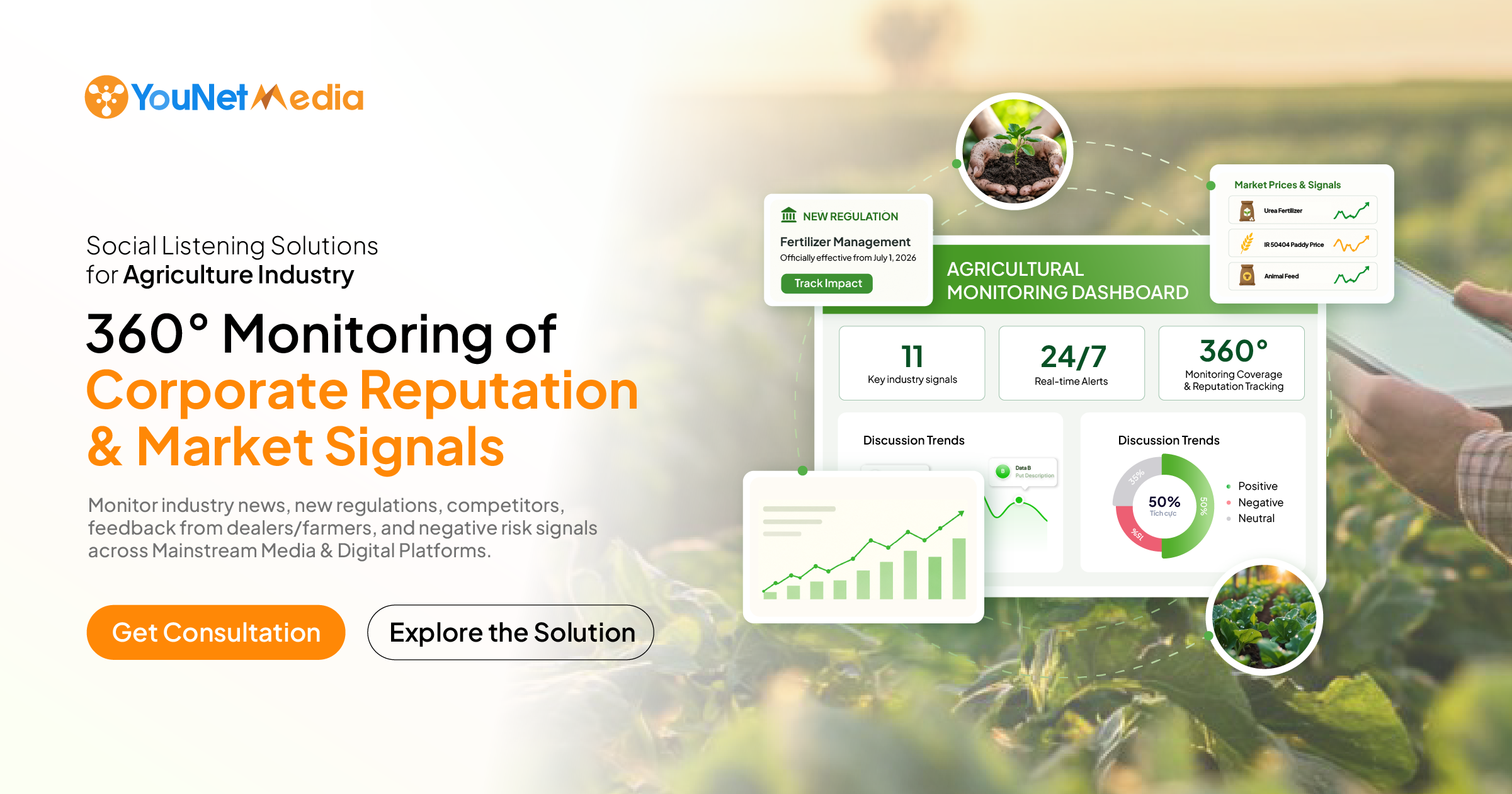
In response to this need, YouNet Media has developed a 360° Monitoring of Corporate Reputation & Market Signals for the Agriculture industry, helping businesses gain a full view of the landscape and respond promptly to industry movements.
Learn more and request a consultation here!
1. When market signals become increasingly fragmented
Agriculture-related market news no longer sits within a single channel. Instead, it is spread across:
- Mainstream media, industry portals, and social media.
- Farmer groups, distributor channels, and local communities.
- Smaller discussions and community reactions around crop seasons, input prices, disease outbreaks, import-export policies, counterfeit/imitation/low-quality products, misinformation, competing products, and more.
The digital landscape has also accelerated how quickly signals can spread. According to Digital 2026: Vietnam by DataReportal, Vietnam had around 85,6 million internet users by the end of 2025 and 79 million identity-verified social media users as of October 2025.
These figures not only reflect the widespread adoption of the internet, but also show that the digital environment has become an important layer of information infrastructure in daily life and market activities.
This means signals related to brands, products, policies, competitors, or risks no longer exist only within internal reports or mainstream media channels.
A post about product quality, a rumor about counterfeit goods, an update about a factory, or a discussion around a new policy can emerge across multiple channels before the business officially captures it.
2. The limitations of manual news checking and monitoring
In many businesses, industry news monitoring still relies heavily on PR or Marketing teams manually checking updates every day. This approach may work when the volume of information is still small, but it becomes limited when the scope expands across multiple brands, subsidiaries, factories, leaders, competitors, policies, the broader market, and social media.
The issue is not only the amount of information. The bigger challenge lies in identifying which signals truly require attention. Not every negative discussion creates risk, but some early-stage signals, however small, can spread widely when they are connected to product quality, counterfeit goods, local communities, or regulators.
For example, counterfeit and low-quality fertilizers and crop protection products remain a notable risk in the industry. According to media reports, the use of counterfeit or low-quality crop protection products and fertilizers can reduce yield and agricultural product quality, increase production costs for farmers, and affect legitimate manufacturers.
This type of issue does not only impact revenue. It can also directly affect brand trust if information is misunderstood or spreads beyond the company’s control.
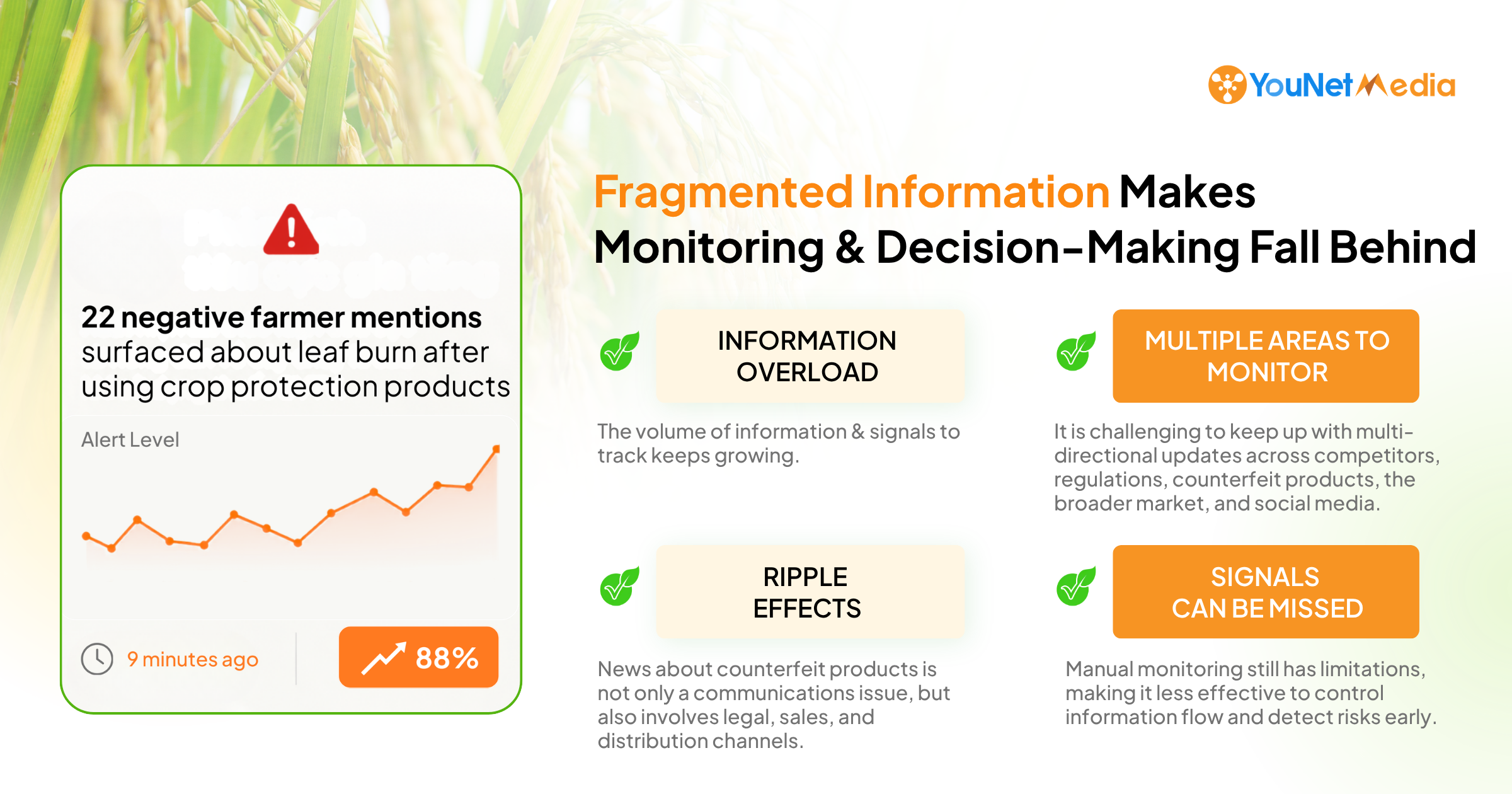
More importantly, information delays can affect multiple departments at once. News about counterfeit goods is not only a communications issue, but also involves legal, sales, distribution channels, and brand protection.
A change in export policy is not just industry news. It can influence communication direction, external relations, and market planning. For this reason, monitoring should be seen as part of the decision-making system, not merely as a news aggregation task.
=> Stay updated industry movements
with Newsletter.
3. The 360° Reputation & Signal Monitoring Solution tailored for the Agriculture industry
The solution is designed to help businesses monitor industry news, new policies, competitors, feedback from distributors/farmers, and negative risks across both the press and digital media channels.
The solution focuses on several core needs. First is Crisis Alert, helping businesses detect early content related to the brand, leaders, factories, distributors, counterfeit goods, or product quality.
Second is Market News Briefing, including Media Clipping from official news sources and Daily Highlights from online news and social media, helping leadership and communications teams keep track of important developments every day.
Third is Reputation Reporting and Continuous Monitoring Dashboard, supporting the measurement of brand health, visibility, discussion sentiment, key topics, and competitor benchmarks.
This approach enables businesses to view the market from a more 360° perspective: not only monitoring their own brand, but also the ecosystem surrounding it, from competitors, distributors, policies, and crop seasons to risk signals that may influence market trust.
4. From media data to early-response capability in modern agriculture
The value of a social listening system does not lie in the amount of data collected, but in its ability to filter and turn data into meaningful signals for decision-making.
This is especially important because each signal may be relevant to multiple decision-making groups:
Leadership needs to understand the overall picture of the industry, competitors, and reputation risks.
PR needs to know which negative news requires a response or continued monitoring.
Marketing needs to understand market reactions to seasonal campaigns, livestreams, technical content, or promotional programs.
Sales and Trade Marketing need to observe signals from distributors, pricing, counterfeit goods, product shortages, or competitor activities.
When these signal groups are continuously monitored, businesses gain a stronger basis for assessing the situation, prioritizing resources, and responding more consistently to market changes.
From this perspective, the Reputation & Market Signal Monitoring Solution for the Agriculture industry can become one component of a modern reputation monitoring capability, helping businesses not only understand what the market is saying, but also identify:
- Which signals are changing.
Which signals should be prioritized.
Which signals may affect the organization’s long-term decisions.
5. Register to learn more about the Social Listening Solution for the Agriculture industry
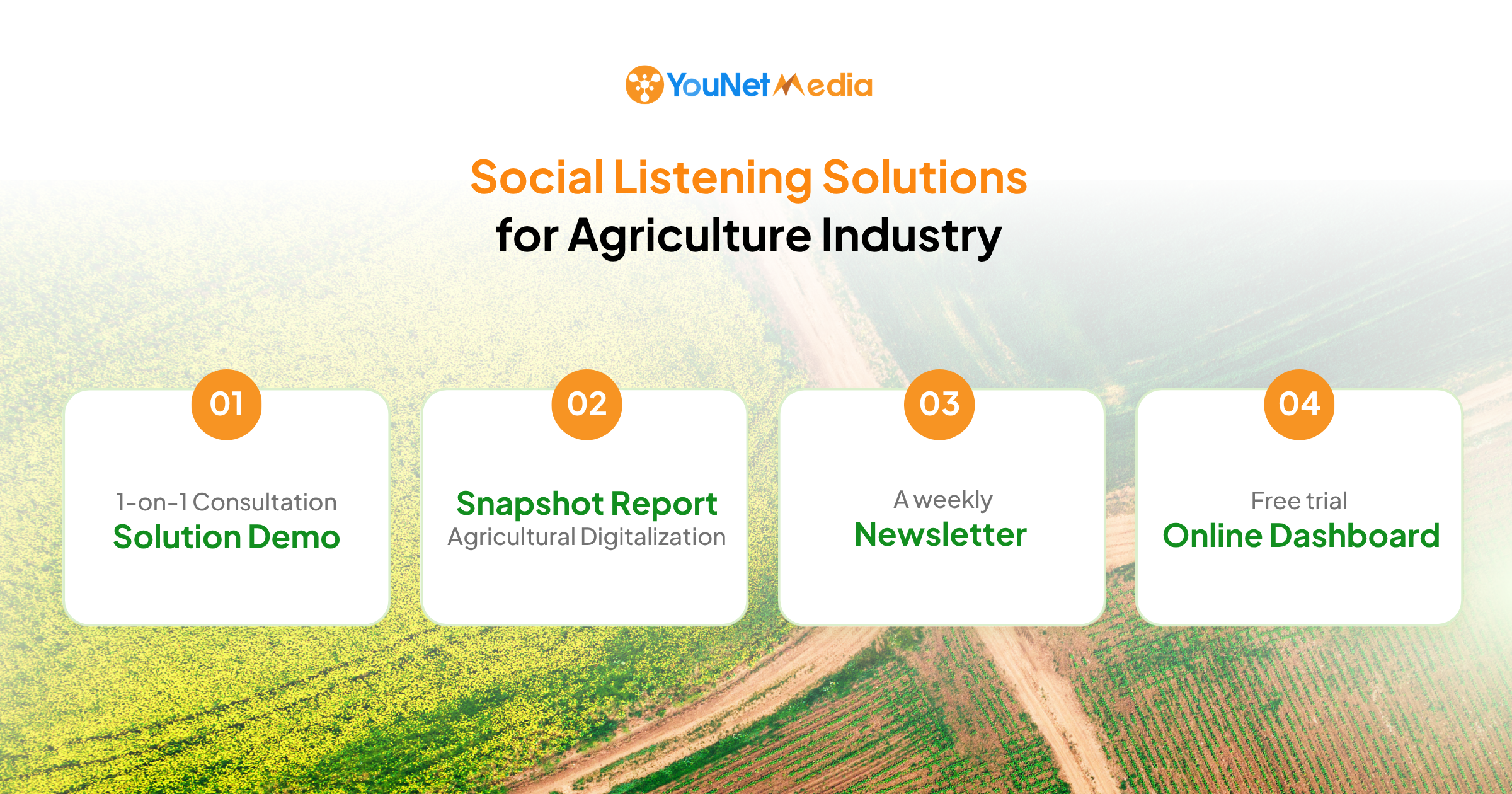
To help businesses begin monitoring reputation and market signals in a more systematic way, YouNet Media provides:
- A 1-on-1 consultation session with experts and a Solution Demo.
A free Agriculture Industry Snapshot Report 2025–2026, covering 11 signals to monitor and Digitalization Trends.
A free trial of the Online Dashboard, helping businesses clearly observe signal shifts by topic, source, channel, sentiment, competitors, and unusual signals over time.
A weekly Newsletter to quickly stay updated on notable industry news across the press and social media.
=> Register Now to Review Market Signals
by sub-sector & Monitor brand reputation 360°.